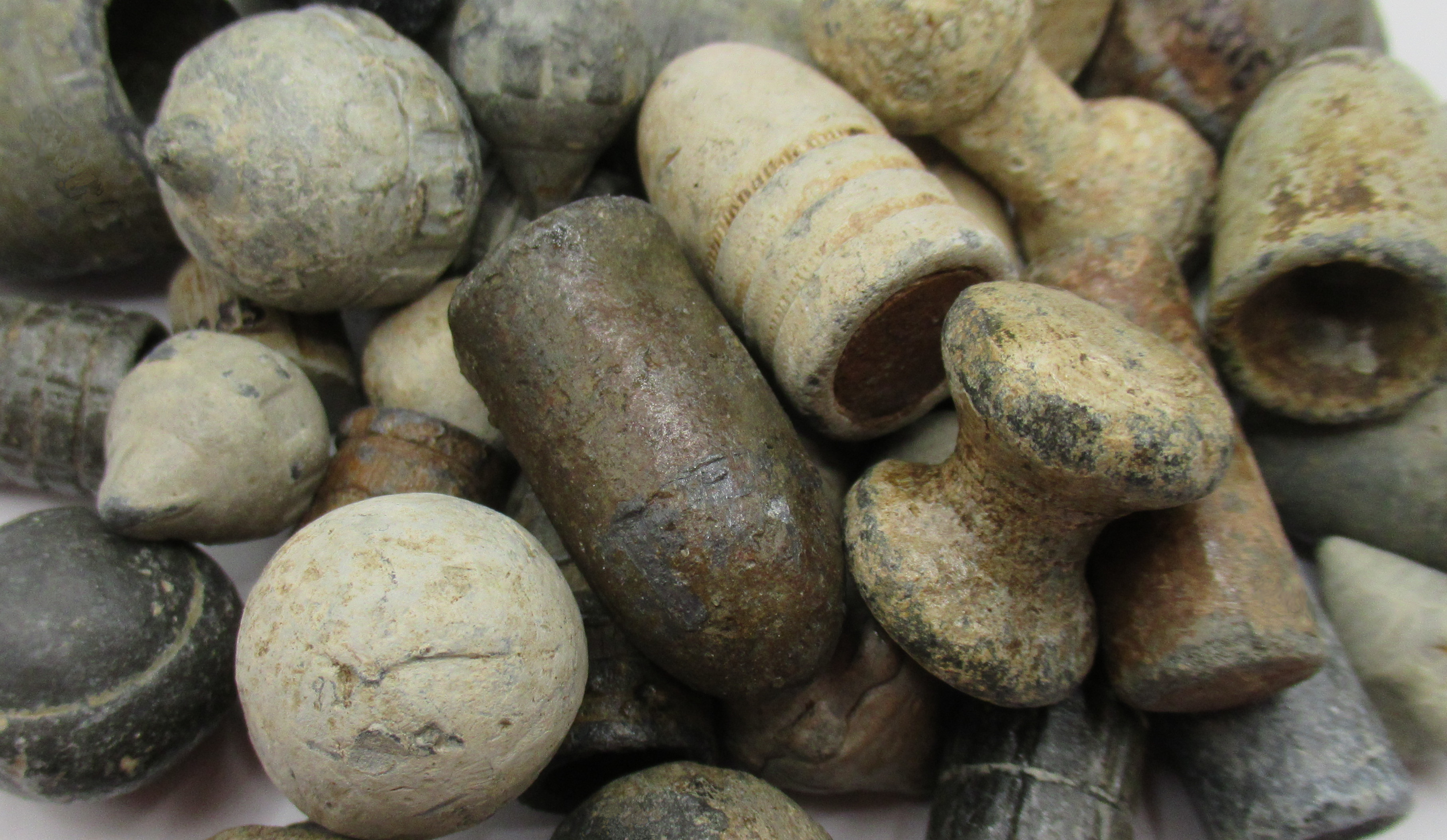
There are many sources for information about 19th century British service bullets available, both historic and modern, but the quality of the illustrations they provide often varies considerably. Official contemporary documentation provides accurate illustrations, sometimes with measurements, but many privately published 19th century publications present (and repeat) illustrations of projectiles that are almost unrecognizable from the originals they are meant to depict. The great Hans Busk, for example, who wrote many excellent books on rifles and Volunteers, is unfortunately guilty of publishing a set of projectile illustrations in his Handbook for Hythe that often deviate from reality (in part this is due to being copied from a set of illustrations from Des Armes Rayees, published 1857). This website will attempt to provide illustrations and photographs only of physically examined specimens, rather than reproducing images already available. Following this approach there will undoubtedly be gaps in the catalogue, where there are no specimens available. Some of the projectiles covered here are in poor condition, having been buried for 150 years or more, but where these are the only examples available, they are presented in that condition. Equally problematic is that the bulk of the specimens looked at are fired. The process of firing a bullet (wherein the bullet sets-up and fills the bore of the rifle) causes the projectile to change shape; in the case of muzzle loaded projectiles, this is significant enough to cause some difficulties with identification. The 4th pattern P53 bullet, for example was 0.550 in in diameter, compared to the 0.568 in diameter of its predecessor. After being fired, both bullets expanded to 0.577 in.
The bullets shown in the illustrations have been drawn from measurements and photographs, while the internal cavity shapes (where present) have been rendered using casts of silicone rubber. Lead is a toxin and precautions have been used in handling the materials shown. After being washed, where possible, the projectiles have been coated with an acrylic lacquer, to limit corrosion, prevent ingestion of lead dust and allow safer handling.
Weights are predominantly given in grains and dimensions in inches, although, and generally the equivalent millimeters and grams are presented for those not familiar with the avoirdupois/imperial scales of units.
The site will grow slowly but steadily, so please check in to see on its progress.
All material on this website, unless otherwise stated, is copyright to J. Russell.
A treatise on projectiles does not condone illegal digging, metal detecting or trespassing. For a superb example of a modern detecting and landscape survey group, see the Field Detectives, based in Nottinghamshire.
If you wish to use any of the information, please get in touch via the contact form.