The Martini-Henry rifle was approved for service in 1871 but it was not until late 1874, after numerous modifications and trials, that it was finally accepted into the army and navy. By that time three marks of cartridge had been introduced and a fourth was about to be rolled out. All featured a bullet made of an alloy of 12 parts lead and one part tin, which was wrapped in a paper patch. The base of the bullet had a slight recess, not for expansion, but for the end of the patch to be twisted into. The bullets are given the name of the mark of cartridge that they belong to.
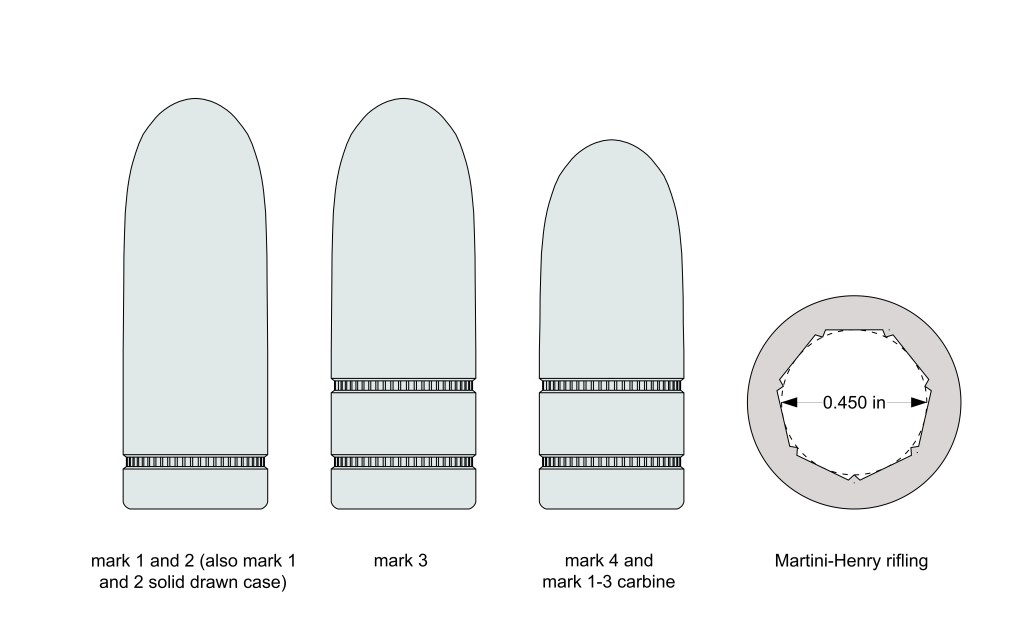
Rolled case, rifle mark 1 (1871) and 2 (1873) featured one knurled cannelure, the differences between marks lying with the case. Bullet weight 480 gn.
Rolled case, rifle mark 3 (1873) featured two knurled cannelures (for improved securing in the case). Bullet weight 480 gn.
Rolled case, rifle mark 4 (1874) featured two knurled cannelures and saw a reduction in bullet length, in an attempt to reduce recoil in the rifle. Bullet weight 410 gn. Production discontinued in either 1875 (according to Neil Aspinshaw, The Martini-Henry For Queen and Empire) or 1880 (according to Peter Labbett, British Small Arms Ammunition 1864-1938), while production of the mark 3 had resumed in 1875.
Rolled case, carbine mark 1 (1877), mark 2 (1878) and mark 3 (1879) all featured a lighter and shorter bullet of the same design as the mark 4 rifle bullet.
Eley produced a rolled cartridge in 1877 which was approved for service use in 1885 (contract cartridge ‘E’) and the bullet was the same as the mark 3.
Kynoch produced a rolled cartridge in 1888 (contract ‘K’), believed to feature the same bullet as the matk 3.
Solid drawn case, rifle mark 1 and 2 (both 1885) featured one cannelure and due to its similarity, may be mistaken for the mark 1 and 2 bullet.
Mark 1 and 2 bullets will seldom be found, due to being replaced by the mark 3 cartridge before the rifle itself was officially issued. The mark 3 bullet is the one most often encountered, due to the longevity of its parent cartridge. As will be noted from above, the mark 4 rifle and marks 1-3 carbine bullets are identical. The marks 1 and 2 rifle bullet and the solid drawn marks 1 and 2 bullets will be extremely hard to differentiate.
The rifling of the Martini-Henry (the part for which Alexander Henry gave his name) is very distinctive and is formed from seven flat sides, the intersections of which are joined by a small ridge. The 0.450 calibre is measured across an imaginary circle scribed through the tips of the ridges and the centre of each of the seven sides.
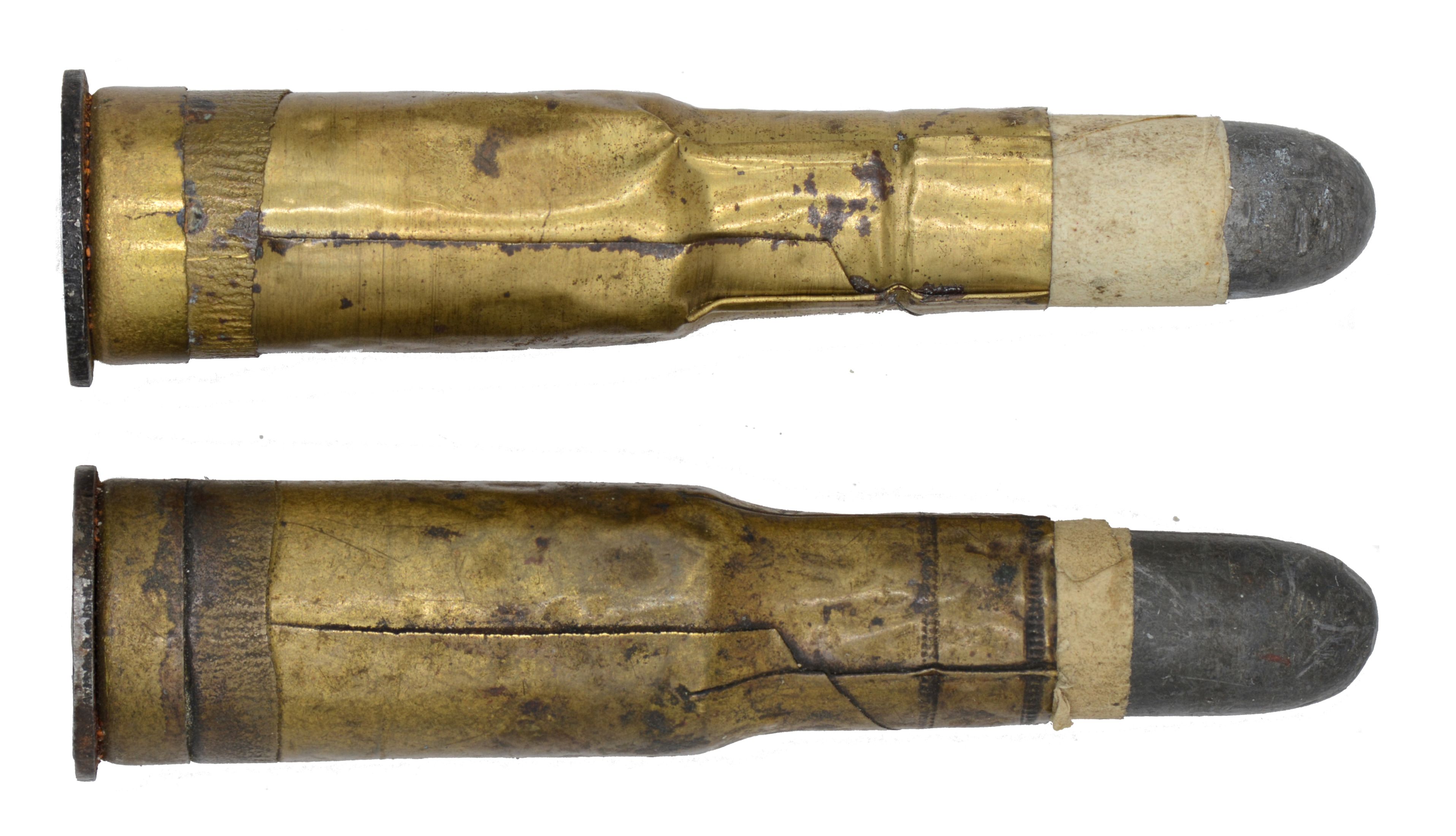
The top cartridge is the mark 1 Martini-Henry and the bottom is the marks 3. Note the one cannelure/neck crimp on the mark 1 and the two cannelures/neck crimps on the mark 2.
Martini-Henry introduction
mark 4 (1874) and carbine mark 1 (1877), 2 (1878) and 3 (1879)
