Soon after the Colt percussion revolvers were purchased in 1854, contracts for a number of Deane and Adams revolvers were placed in 1855 and 1856. The revolver had evolved from the earlier Adams percussion revolver and incorporated an improvement by Lieutenant Beaumont, as well as new patents from Deane and Adams. One of the most significant changes was that the revolver now had a loading lever. This dispensed with the need for the original cartridge (featuring a wad retained on a stem extending from the rear of the bullet) and meant the ammunition could now be made up as ‘skin’ cartridges. The ‘skin’ cartridge involved a wrapper around the base of the bullet, made from animal intestines (not skin at all) and presented a very thin retaining layer, which would entirely combust, on firing. The concept was patented in 1856 by Captain Hayes and subsequently used for a number of years. The intestine wrapper was very fragile, so a paper case (an Eley patent) was supplied in which the cartridge was placed during storage and transit. Deane and Adams’ revolvers were supplied for service in two sizes: 38 gauge (approximately 0.500 in) and 54 gauge (approximately 0.440 in). Measured specimens of the revolvers have bores of 0.494 in for the 38 gauge version and 0.434 in for the 54 gauge version (Revolvers of the British Services, 1854 to 1954, Chamberlain and Taylerson, 1989, page 3). The List of Changes records the diameter for the bullets for these two revolvers as being 0.457 in for the 54 gauge in 1863 (no, 857) and 0.492 in for the 38 gauge in 1864 (no. 884). The 54 gauge is noted as substituting the Hayes pattern skin cartridge (LoC no. 558 1862). The exact shape of the Hayes projectile, or indeed the projectiles prior to adoption of the Hayes patent (dates in the LoC occasionally are added some time after adoption) is not clear.
Official weight and dimensions (from List of Changes 857 and 884):
54 gauge
- Weight: 214 gn (13.8 g)
- Diameter: 0.457 in (11.6 mm)
- Length: 0.630 in (16 mm)
38 gauge
- Weight: 245 gn (15.9 g)
- Diameter: 0.492 in (12.5 mm)
- Length: 0.660 in (16.7 mm)
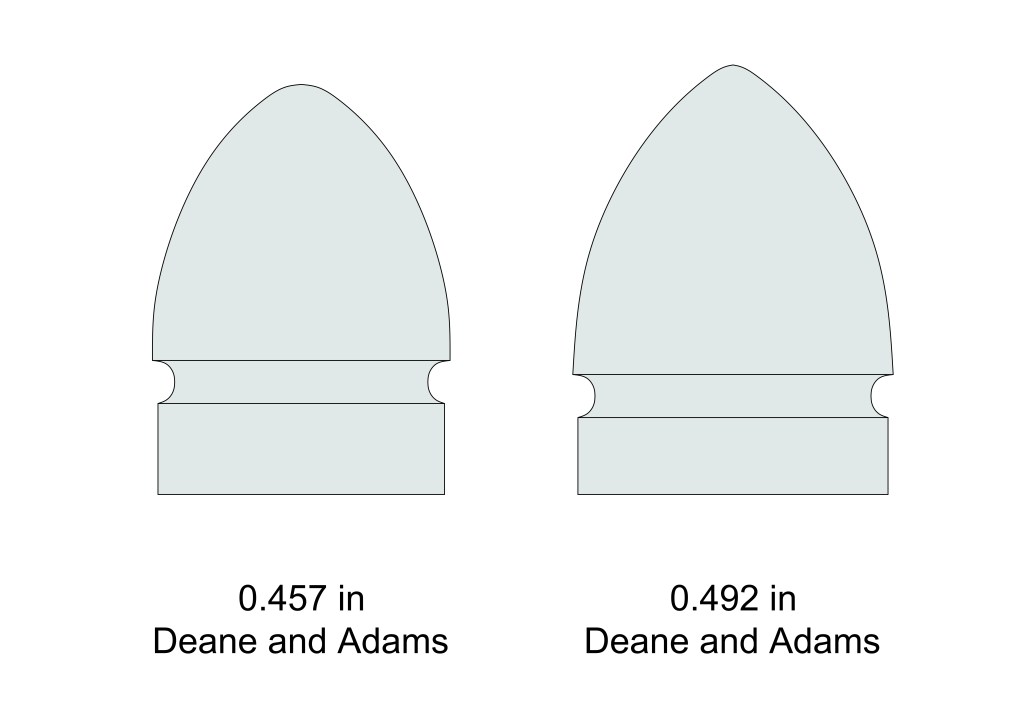
The illustrations above showing the 54 gauge bullet on the left and 38 gauge bullet on the right, are taken from the List of Changes drawings. Unfortunately I have not come across any definitive fired projectiles of these types so there are not real versions to compare.
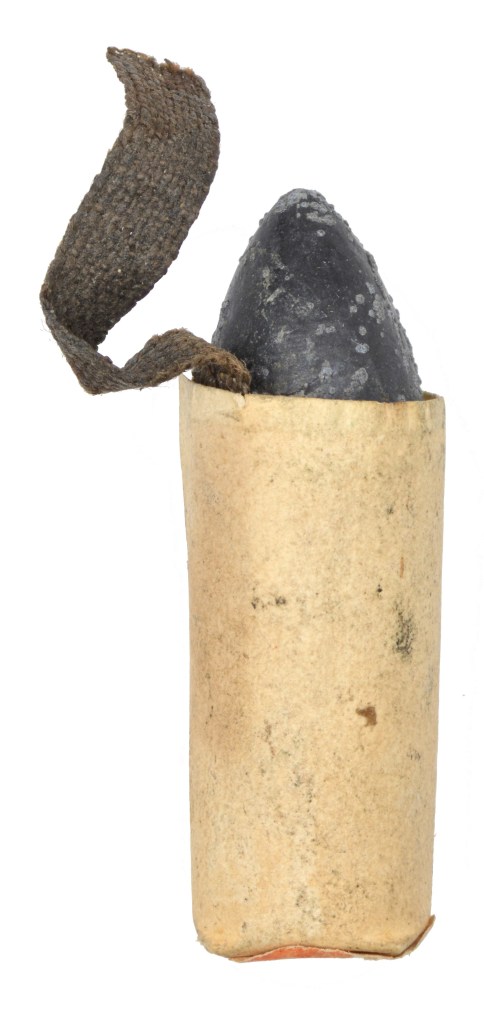
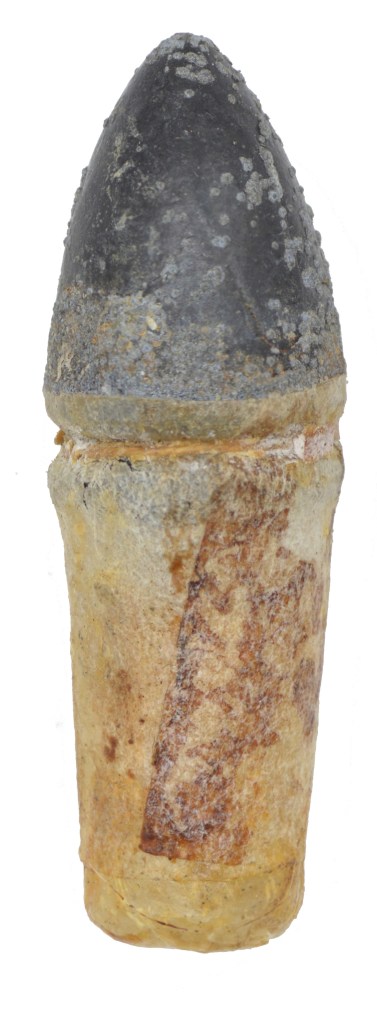
The above images show an Eley skin cartridge of the general form, in its protective outer case on the left and the intestine powder wrapper on the right attached to the base of the bullet, ready to be inserted into the cylinder. The diameter of this projectile is 0.465 in (11.8 mm) and it weighs 214 gn (13.8 g). The weight matches the 54 gauge projectile and the diameter may have been increased by the corrosion visible on the bullet. It does however, appear to be a longer bullet than that illustrated in the LoC, perhaps a variation for the commercial market.
Deane and Adams percussion revolver
