In 1851 Britain awoke to the revolver, when Samuel Colt and Robert Adams both exhibited their wares at the Great Exhibition in Hyde Park. Colt had introduced his revolver in 1836, the expiration of which patent occurred in the same year as the Great Exhibition. Adams may well have benefited from this, but his own revolver was of suitably different construction to become a significant rival. The percussion revolver bullets discussed here are those that were used in service by the British military, whether unofficially (as with the early Adams projectiles) and officially as with the Colt and all were loaded into the front of the cylinder (an intermediate step in the evolution between muzzle and breech loaded pistols).
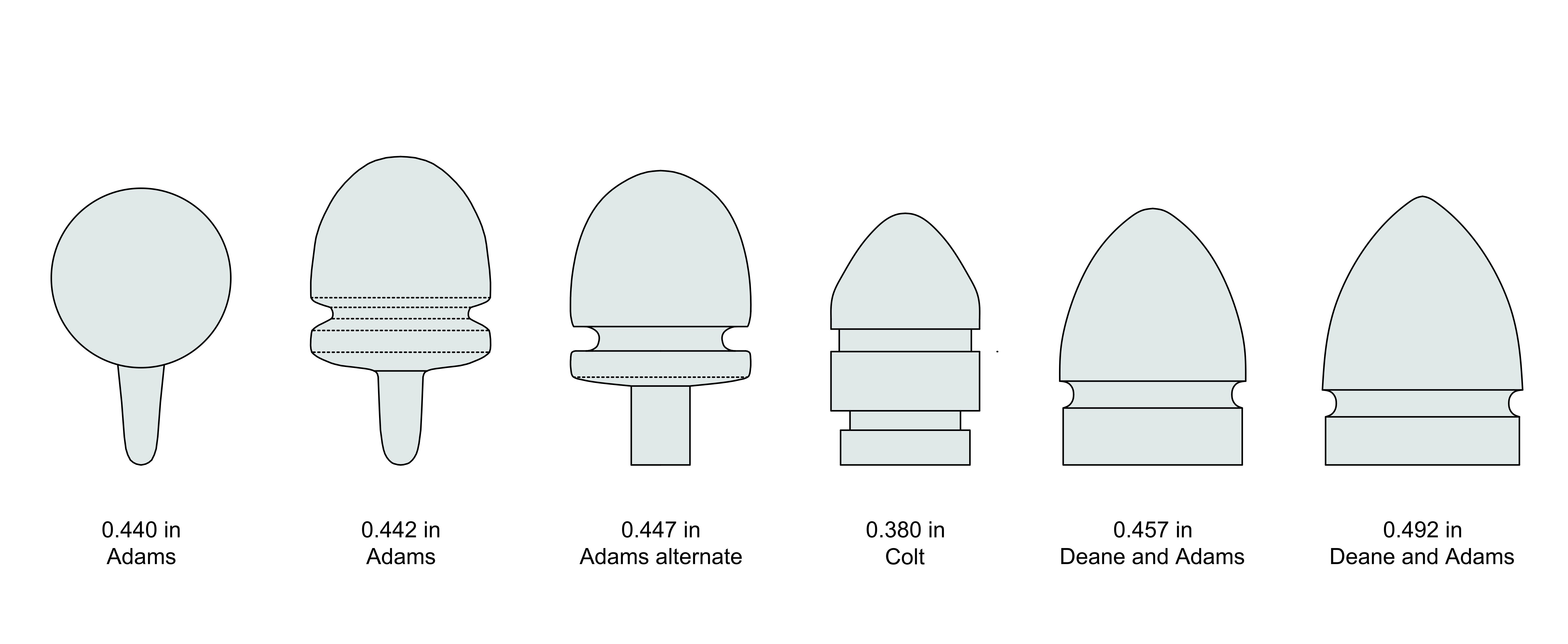
The illustration above shows the early bullets for the Adams revolver (the first three bullets on the left), the Colt Navy bullet and two bullets for the Deane and Adams revolvers. The reason for the long stem at the base of the early Adams bullets, is to attach a wad and a powder container. The large wad enabled to bullets to be pushed home with finger or thumb, yet stopped them from falling out of the cylinder. The Colt and later Deane and Adams revolvers featured a loading lever, which pushed the bullets firmly into the cylinder, so that they expanded laterally and would not slip oot, thereby doing away with the need for the wad.
Percussion revolvers
