The Snider rifle, approved for service in 1866, was based upon the concept of converting P53 muzzle loaded rifles into breech loaded rifles. Its time in the spotlight was short, having only seven years of dominance before the Martini Henry emerged, although it was used into the 1890s as a reserve rifle. In those first few years, however, nine different patterns of cartridges were produced and there is a little bit of explanation of these required before jumping in to the bullet types. Unlike P53 cartridges, the Snider cartridges had pattern numbers from the outset. This changed in 1868 when the term ‘mark’ was introduced to replace ‘pattern’, with the mark IV cartridge. The bullets within these groups do not necessarily change with each new designation; the bullet for the pattern 1 cartridge is the same as the bullet for the pattern 2 cartridge, for example, so the descriptions of bullets will adhere to the cartridge marks.
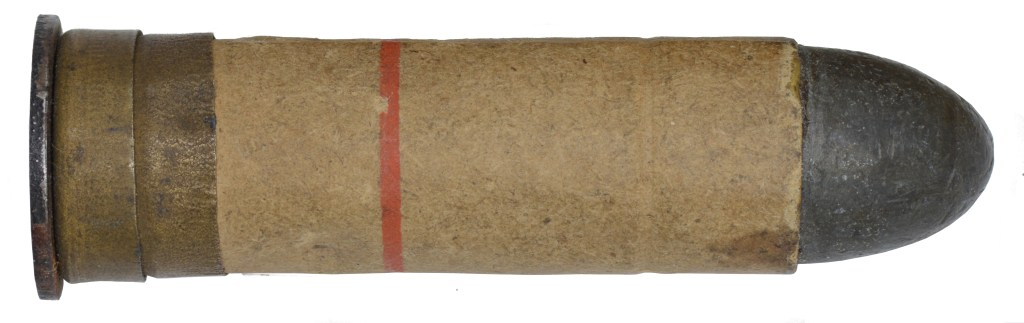
This is an inert Mk 9 Snider cartridge. To see complete the complete range of Snider cartridges, visit the excellent website by the late Tony Edwards, British Military Small Arms Ammunition https://sites.google.com/site/britmilammo/home
The bullets for Snider cartridges all featured cannelures, designed to hold lubricant – the cannelures were the same thickness as the rifling, so the theory was that as the bullet was projected forwards, it expanded into the rifling which in turn cut into the cannelures and the lubricant was easily distributed. The base cavity retained the clay plug used in the last pattern of P53 bullets, but in addition to this, a nose hollow was introduced. W. E. Metford designed an explosive bullet for the P53, approved in 1863, featuring a hollow nose, into which an explosive compound was placed. When the explosive was replaced with an inert charcoal substitute, the bullet was found to shoot more accurately than the regular bullet. This seems not to have escaped the attention of Col. Boxer at the Royal Laboratories, who designed the first official version of the Snider bullet and instead of charcoal, the nose hole was filled with a cylindrical sycamore plug. The bullet for the new rifle was now made of three separate components, rather than just the two of the final pattern of P53 bullet.
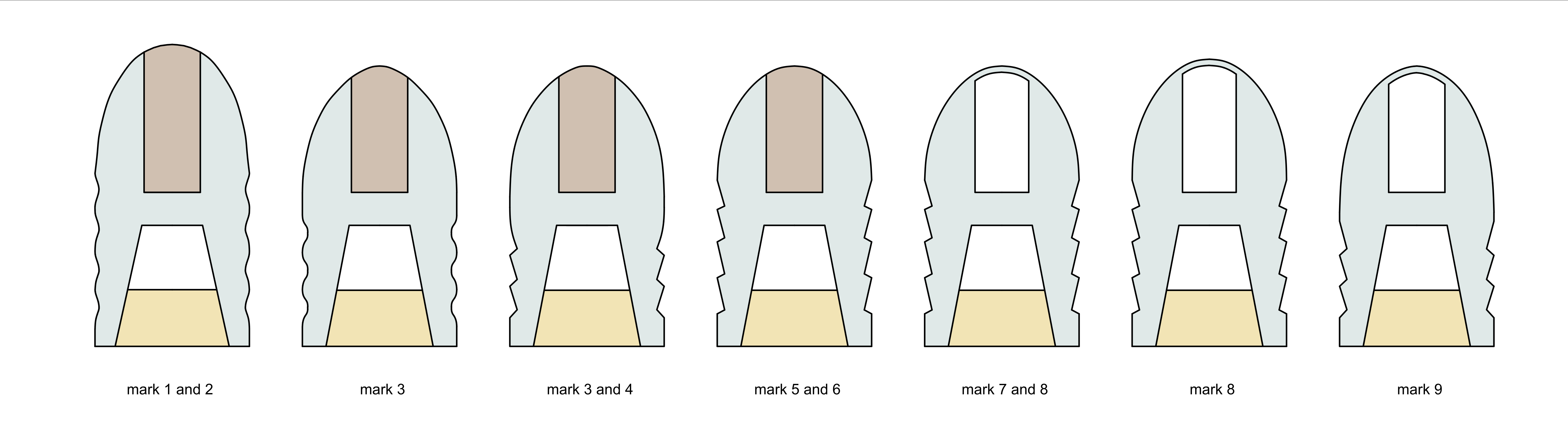
The bullet for the mark 1 and 2 cartridge were identical (the difference in marks relating to the case): clay plug, sycamore nose plug, four rounded cannelures. The mark 1 was was for all arms, the mark 2 for the naval short Snider only.
The mark 3 was slightly shorter than the previous bullet and began life with three rounded cannelures, which changed soon after, to three saw-tooth cannelures. This cannelure format remained in place for the mark 4 bullet. Both of these were intended for all arms except for the naval rifle.
The mark 5 and 6 cartridge bullet saw a return to 4 cannelures, but of the saw-tooth type and was intended for all arms (there was no longer a differentiation for the naval rifle).
The mark 7 and 8 cartridge bullet did away with the sycamore nose plug. The hollow was retained, but ‘spun over’ with lead (a process of cold shaping the lead nose, by rotating the bullet against a former) resulting in the nose having a solid appearance.
The mark 8 bullet is referred to by B. A. Temple (in The Boxer Cartridge in the British Service) as being slightly longer than previous marks. No other reference to this has been found.
The mark 9 cartridge bullet, introduced in 1871, was to be the design settled upon for the remainder of the service life of the rifle. A mark 10 cartridge (not illustrated here) is referred by Edwards and Labbett, but remains a bit of a mystery. Not recorded in the List of Changes, the cartridge appears to have been introduced in India and featured 3 rounded cannelures. Commercially produced solid drawn cartridges were manufactured towards the end of the 19th century, but will not be covered in this section as they were not adopted for service use.
Although Snider bullets feature base cavity stamps, these are generally not visible, due to the presence of the clay plug. Unless the bullet hits a surface hard enough to dislodge the plug, it will remain in-situ and is not affected by decay, unlike the wooden plugs of the P53 bullets. There are no base cavity rim broad arrows on any Snider bullets.
Snider introduction
